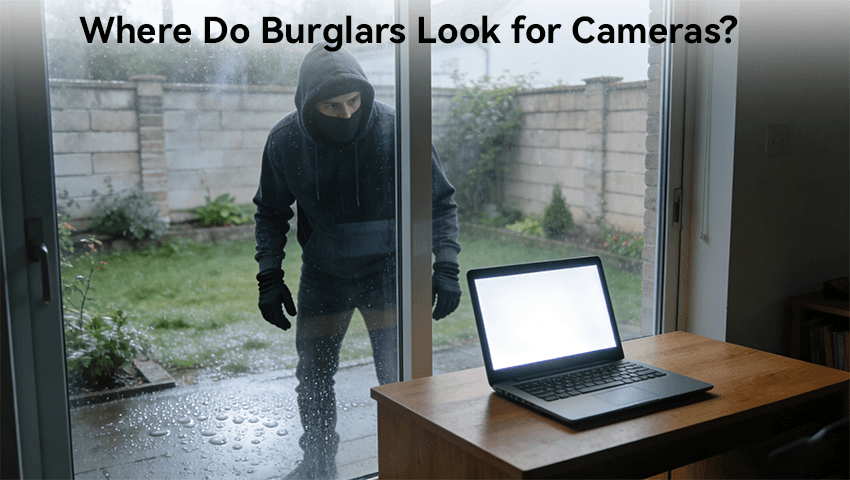
Most homeowners assume that installing a few cameras is enough. But seasoned burglars don’t just notice cameras—they analyze them. They look for patterns, weaknesses, and opportunities to slip through unnoticed.
If you really want to protect your home, it helps to understand not just where burglars look—but how they evaluate your entire surveillance setup.
The Burglar’s Mindset: Risk vs. Reward
Burglars typically make decisions in seconds. Their internal checklist looks something like this:
Can I be seen?
Can I avoid being identified?
How fast can I get in and out?
Cameras directly affect all three. A well-designed system increases perceived risk, while a poorly planned one can actually give burglars confidence.
Contents
Tip 1: Make a Strong First Impressions: The “Walk-By Scan”
Before attempting anything, many burglars perform a quick visual scan from the street.
What they’re looking for:
Cameras pointing only at obvious areas (like the front door)
Gaps between camera coverage zones
Blind angles created by walls, trees, or decorations
Whether cameras are real, powered, and active
What gives you away:
Cameras that are too small, fake-looking, or poorly positioned
Lack of visible wiring or activity (no indicator lights at night)
Outdated models with limited field of view
How to counter it:
Create the impression of full coverage. Even one visible, well-placed camera can deter—but multiple strategically placed units make your home feel “too risky.”
Tip 2: Secure Every Possible Entry Point
After the initial scan, burglars focus on how they might enter undetected.
Doors
Is the camera directly facing the door—or just nearby?
Can they approach from the side without being seen?
Is the camera mounted low enough to be tampered with?
Windows
Are ground-floor windows covered?
Can they stay below the camera’s line of sight?
Does glare or reflection reduce visibility?
Side & Back Access
Are there areas hidden from street view and cameras?
Do fences or structures create natural blind spots?
Key insight:
Burglars don’t need total invisibility—just a few seconds outside your camera’s field of view.
Tip 3: Eliminate Camera Blind Spots
Even homes with multiple cameras often fail here.
Common issues burglars exploit:
Narrow field of view – easy to step outside coverage
Fixed angles – predictable and avoidable
Overlapping gaps – small zones where no camera sees clearly
Improper height – too high (no facial detail) or too low (easy to disable)
Real-world tactic:
A burglar may approach slowly, watching how cameras are positioned, then move between their fields of view.
How to counter it:
Think in layers:
Wide-angle coverage for general monitoring
PT (pan & tilt) cameras for active tracking
Overlapping zones to eliminate gaps
Tip 4: Strengthen Your Nighttime Surveillance
A large percentage of break-ins happen at night—and burglars know many cameras perform worse in low light.
What they test:
Are there dark areas outside the camera’s reach?
Does the camera rely only on infrared (black-and-white footage)?
Are there light sources causing glare or overexposure?
Weakness signals:
Grainy or blurry night footage
Limited illumination range
Strong reflections washing out the image
How to counter it:
Use cameras with true color night vision and smart lighting. A well-lit scene doesn’t just improve footage—it makes burglars feel exposed.
Tip 5: Use Active Deterrence, Not Just Recording
Burglars don’t just study cameras—they study you.
They may check:
Do lights or cameras react to motion?
Are alerts triggering visible changes (like lights turning on)?
Is there any sign of real-time monitoring?
Why it matters:
A passive system records crime. An active system interrupts it.
How to counter it:
Use motion alerts, app notifications, and deterrents like sirens or lights. The moment a burglar senses they’ve been noticed, the plan often collapses.
This is where a smarter system makes a real difference.

C296B 4K PTZ PoE Security Camera System
- 4K resolution
- AI Auto Tracking
- PoE Plug and Play
- Full Color Night Vision
- Spotlight & Siren Deterrence
Take the ZOSI C296B PoE Camera System as an example. It’s designed not just to watch—but to respond:
Auto tracking with 355° pan & 140° tilt follows movement in real time, eliminating escape routes and blind spots
AI detection identifies people and vehicles accurately and sends instant alerts to your phone
Two-way audio + built-in siren lets you speak directly or warn intruders immediately
Remote access via app means you can check in and react from anywhere, anytime
This kind of setup changes everything.
Instead of quietly recording, your system can:
Track a suspicious person as they move
Send you an alert within seconds
Let you speak or trigger a siren instantly
That interaction alone is often enough to stop a break-in before it even begins.
Tip 6: Prevent Camera Tampering and Avoidance
If a burglar believes your system is weak, they may try to bypass it.
Common tactics:
Approaching from below or behind the camera
Covering lenses with spray, tape, or cloth
Cutting visible cables
Wearing hoodies, hats, or masks to avoid identification
What makes this easier:
Cameras within arm’s reach
Exposed wiring
No backup recording system
How to counter it:
Install cameras higher and out of reach
Use systems with local storage (so footage isn’t lost)
Combine visible deterrence with hidden backup cameras
Tip 7: Use Psychology to Deter Burglars
Here’s the key: burglars don’t need perfect information—they just need doubt.
A strong camera setup creates questions like:
“Am I already being recorded?”
“Are there more cameras I can’t see?”
“Will someone respond immediately?”
If the answer might be “yes,” most burglars won’t take the risk.
FAQs
1. Where should I place my security cameras to prevent burglaries?
Place cameras at all potential entry points, including the front door, back door, windows, garage, and side gates. Don’t forget to cover blind spots like the backyard, side alleys, and pathways. Make sure your cameras are mounted high enough to be out of easy reach, but positioned to capture facial details and movement.
2. Can burglars disable security cameras?
Yes, but only if they’re positioned incorrectly. Cameras that are easily accessible or have exposed wiring are prime targets for tampering. To prevent this, place cameras higher up, use tamper-resistant housing, and make sure they’re connected to a system with local storage.
3. How can I improve my home’s security beyond cameras?
In addition to cameras, use motion-sensor lights, doorbell cameras, smart locks, and security alarms to create multiple layers of protection. Combine both visible and hidden security measures to make your home seem like a “no-go zone” for burglars.
Conclusion
The difference between a vulnerable home and a secure one isn’t just the number of cameras—it’s how intelligently they’re used.
Walk around your home today and ask yourself:
Where would I try to avoid being seen?
Where would I feel safest approaching?
Those answers reveal exactly where your security needs improvement.
Because in the end, the best security setup does one simple thing incredibly well:
It makes burglars choose another house.
When your home is covered from every angle with the right cameras in place, you’re not just reacting to crime—you’re preventing it before it happens.
Related Posts