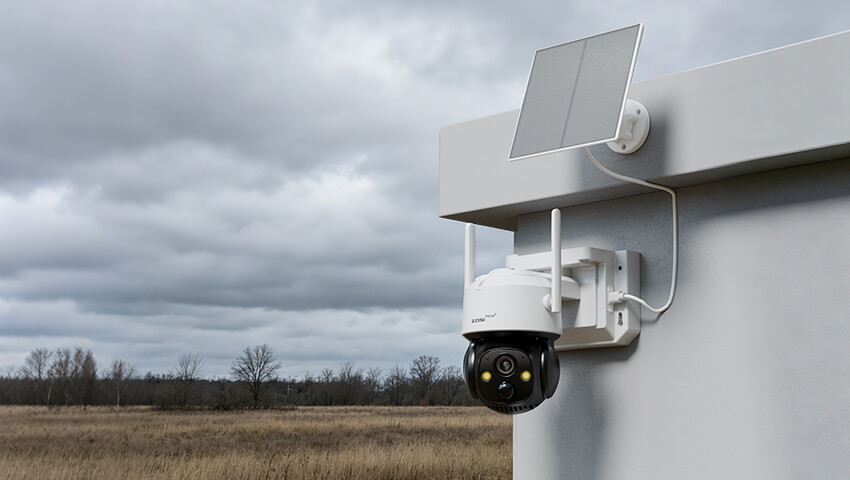
Solar security cameras are widely used for home security, driveways, farms, and remote areas because they eliminate the need for wiring and reduce electricity dependence. However, one of the most frequently asked questions is:
Do solar security cameras still work when the weather is cloudy?
This concern is valid because solar energy depends on sunlight. But modern systems are not designed to rely on instant sunlight alone—they combine energy harvesting, storage, and power management to ensure continuous operation.
In most real-world conditions, solar security cameras continue functioning normally even during cloudy weather. The key is understanding how they manage energy.
Contents
How Solar Security Cameras Actually Work
To understand cloudy-day performance, it’s important to break down the system:
1. Solar Energy Collection
Solar panels use photovoltaic (PV) cells to convert light into electricity.
Importantly, this does not require direct sunlight. Any visible light—direct or diffused—can generate power.
2. Energy Storage System
The electricity generated by the solar panel is stored in a built-in rechargeable lithium battery.
This battery acts as the camera’s main power source, especially at night or during periods with limited sunlight. A properly designed solar security camera system balances solar charging, battery storage, and power consumption to maintain reliable operation in different weather conditions.
For a detailed explanation of solar panel installation, battery storage, and how to set up a complete solar-powered security system, check out our guide on How to Solar Power Your Wireless Outdoor Security Cameras.
3. Power Consumption System
Solar cameras are designed for low power usage:
- Standby mode when no motion is detected
- Event-based recording (not continuous recording in many models)
- Smart AI filtering to reduce unnecessary wake-ups
This energy-efficient design is what allows long-term operation even under variable weather conditions.
Do Solar Panels Work on Cloudy Days? (Technical Explanation)
Yes — and this is one of the most misunderstood parts of solar technology.
Even when clouds block direct sunlight:
- Sunlight is scattered in the atmosphere
- This creates diffuse radiation
- Solar panels can still convert this light into electricity
| Condition | Solar Energy Output |
| ——————- | ——————- |
| Bright sunny day | 100% |
| Light clouds | 60–90% |
| Heavy clouds | 20–50% |
| Storm clouds | rain | 10–25% |
Key Insight:
Even at 20–50% efficiency, solar panels are still producing usable energy.
This is enough to maintain battery charge or slow down discharge—not necessarily fully recharge, but keep the system stable.
What Actually Happens on Cloudy Days (Real Behavior)
Solar cameras do not behave like devices that “turn off” when sunlight is reduced.
Instead, they operate in three energy states:
1. Normal Operation (Sunny Conditions)
Solar panel charges battery continuously
Camera runs and replenishes energy at the same time
Battery stays near full capacity
2. Balanced Operation (Partly Cloudy Conditions)
Charging slows down
Battery supplies more power than solar input
System still operates normally
3. Energy Reserve Mode (Extended Cloudy Conditions)
Solar input is very low
Camera relies mainly on stored battery
Non-essential features may reduce activity (depending on model design)
This is why good solar cameras can still function for days without sun.
What Happens During Multiple Cloudy Days?
This is where system design becomes critical.
If cloudy weather continues for several days:
Step 1: Battery Takes Over
The camera runs entirely on stored energy.
Step 2: Reduced Charging Input
Solar panel provides minimal replenishment.
Step 3: Gradual Battery Drop
Energy level decreases depending on usage.
Step 4: System Optimization (Model Dependent)
Some advanced cameras may automatically:
reduce motion wake-ups
lower transmission frequency
optimize night vision usage
Important Insight:
The camera does NOT instantly fail — it gradually adjusts based on available energy.
Key Factors That Determine Cloudy-Day Performance
Cloudy weather alone is NOT the main issue. Performance depends on system design and installation quality.
1. Battery Capacity (Most Important Factor)
A larger battery = more backup days without sunlight.
Think of it like a water tank:
bigger tank = longer supply during drought
2. Energy Consumption Level
Power usage varies significantly based on:
Number of motion triggers
Recording length
Live view usage
AI detection processing
Night vision usage
A busy location drains batteries faster than a quiet one.
3. Night Vision Power Usage
Night operation is one of the highest energy-consuming periods.
Features like:
infrared LEDs
spotlight illumination
full-color night vision
can significantly increase power draw.
4. Solar Panel Efficiency
Not all panels perform equally in low light.
High-efficiency panels:
capture more diffused light
charge faster during cloudy weather
recover batteries quicker after usage
If your camera isn’t charging as expected, the issue may not be the weather alone. Dirt buildup, cable connections, installation angle, or battery health can all affect charging efficiency. Our guides on solar panel problems and solutions and why your solar panel is not charging the battery cover the most common causes and practical fixes.
5. Installation Angle & Environment
Even a powerful solar system can underperform if installed incorrectly.
Common issues:
shade from trees or walls
north-facing installation in some regions
seasonal sun angle changes
dust accumulation
Proper placement helps maximize sunlight exposure and ensure consistent camera performance. For homeowners looking to monitor open outdoor areas, such as driveways and front yards, solar security cameras offer a flexible solution without complicated wiring. Learn more in Why Solar Security Cameras Are Ideal for Driveway & Front Yard Protection.
How Long Can Solar Security Cameras Run Without Sunlight?
This depends mainly on usage intensity and battery size.
Typical Real-World Estimates:
Usage Level Battery Runtime
Low activity (quiet area) 1–3 weeks
Medium activity (home entrance) 5–10 days
High activity (street-facing) 3–7 days
Why ranges vary:
Because solar cameras are event-driven systems, not continuous recorders.
How to Optimize Solar Camera Performance in Cloudy Weather
To ensure stable performance year-round, optimization matters more than weather.
1. Maximize Sun Exposure
- Install in open areas
- Avoid shade from buildings or trees
- Consider seasonal sun movement
If you’re planning a new installation, our guide on How to Solar Power Your Wireless Outdoor Security Cameras includes practical tips for positioning both the camera and solar panel to achieve the best charging performance.
2. Clean Solar Panels Regularly
Dust, pollen, and dirt can reduce efficiency by 10–30%.
3. Adjust Motion Sensitivity
Reducing false triggers can significantly extend battery life.
4. Use Smart Detection Features
Human/vehicle filtering reduces unnecessary recording.
5. Monitor Battery Levels
Early detection of low charge prevents unexpected downtime.
Are Solar Cameras Reliable in Cloudy or Low-Sunlight Regions?
Yes — but system selection matters.
Solar cameras are suitable for:
northern climates with seasonal clouds
coastal areas with variable weather
suburban homes with occasional shade
However, in environments with:
continuous heavy shade
extremely limited daylight
dense forest cover
performance depends heavily on oversizing the solar panel or battery.
FAQs
1. Can solar security cameras charge without direct sunlight?
Yes. Solar panels can generate electricity from indirect or diffused light. Even when the sun is behind clouds, enough light still reaches the panel to produce energy, although at a reduced rate compared to direct sunlight.
2. Will a cloudy day drain my solar security camera battery?
Not necessarily. A single cloudy day usually has minimal impact because the camera runs on stored battery power. However, if cloudy weather continues for multiple days, the battery may gradually decrease depending on usage levels and camera activity.
3. How many days can a solar security camera last without sunlight?
Most solar security cameras can last anywhere from 3 to 14 days without direct sunlight, depending on battery capacity, motion activity, and feature usage such as night vision or live viewing.
4. Do solar security cameras work at night?
Yes. Solar cameras operate at night using energy stored in the battery during the day. Features like motion detection, infrared night vision, and alerts continue functioning after sunset.
Conclusion
Solar security cameras do work on cloudy days. While charging efficiency is reduced under limited sunlight, they continue operating using stored battery power and energy from diffused light.
Performance mainly depends on battery capacity, usage level, and installation quality. With proper setup, most solar cameras can run reliably for several days even without strong sunlight.
In short, cloudy weather slows charging—but does not stop security coverage.
What about your setup?
Have you noticed your solar camera performing differently during cloudy weather, or are you planning to install one soon?
Related Security Guides
- How to Solar Power Your Wireless Outdoor Security Cameras.
- Solar Panel Problems and Solutions
- Why Is My Solar Panel Not Charging the Battery?
- Why Solar Security Cameras Are Ideal for Driveway & Front Yard Protection.
- How to Choose the Best Outdoor Security Camera for Your Home
Related Posts