Security cameras have become a cornerstone of modern home and business security. But when setting up a surveillance system, one of the first decisions you’ll face is choosing the right recording mode. Should your camera record continuously, 24/7, or only when it detects motion? Both options have their advantages and drawbacks, and the choice often depends on your security needs, storage capacity, and monitoring preferences.
In this guide, we’ll break down continuous recording and motion detection recording, compare their pros and cons, and explore practical use cases to help you make an informed decision.
Contents
Understanding Security Camera Recording Modes
Security camera systems today are far more versatile than the simple setups of the past. Modern cameras offer multiple recording modes, AI-based detection, cloud storage, and even hybrid solutions. At the heart of this flexibility are two primary modes: continuous recording and motion detection recording.
Choosing the right mode isn’t just about convenience—it affects how much footage you store, how easy it is to find specific events, and how reliable your system is when it comes to catching incidents in real time. Let’s dive into the specifics.
What Is Continuous Recording?
1. Definition
Continuous recording, sometimes called 24/7 recording, means the camera captures video non-stop. Every second of the day is recorded, regardless of whether there is any activity in the camera’s field of view.
2. How It Works
Continuous recording typically stores footage on a hard drive (HDD), network video recorder (NVR), SD card, or cloud storage system. For IP cameras, footage is streamed constantly, which can consume more bandwidth.
3. Key Advantages
– Full Coverage: Nothing is missed. Every movement, every incident, and every detail is recorded.
– Detailed Playback: Having uninterrupted footage allows for a complete timeline, which is invaluable for investigations or reviewing incidents.
– Consistent Evidence: Continuous footage provides a reliable record in case of disputes or insurance claims.
4. Limitations
– High Storage Requirements: Recording 24/7 quickly consumes HDD or cloud storage space. For instance, a single 4K camera recording continuously can require multiple terabytes per month.
– Bandwidth Usage: Streaming and storing continuous footage can strain networks, especially if multiple cameras are involved.
– Time-Consuming Review: With all footage recorded, finding specific events can be more tedious unless your system supports fast search or tagging.
Continuous recording works best in scenarios where missing even a single event is unacceptable, such as business warehouses, large retail stores, or areas with high-value assets.
What Is Motion Detection Recording?
1. Definition
Motion detection recording only triggers the camera to record when movement is detected in its field of view. This can be based on simple pixel change sensors or more advanced AI algorithms.
2. How It Works
When motion is detected, the camera records a clip, which is then saved to local storage or uploaded to the cloud. Many systems allow you to customize sensitivity and set motion zones to reduce false triggers.
3. Key Advantages
– Storage Efficiency: Only important footage is recorded, saving space on hard drives or cloud storage.
– Simplified Review: It’s easier to locate specific events since recordings are tied to detected activity.
– Lower Bandwidth and Power Use: Especially useful for battery-powered cameras or systems with cloud limitations.
4. Limitations
– Potential Missed Events: Slow or subtle movements may not trigger recording.
– False Alerts: Pets, shadows, or passing vehicles can cause unnecessary recordings if settings aren’t fine-tuned.
– Detection Accuracy Dependent: Effectiveness relies heavily on sensor quality or AI capabilities.
Motion detection is often ideal for home surveillance or areas where storage and power efficiency are priorities, such as front doors, driveways, or small offices.
Continuous vs Motion Detection: Side-by-Side Comparison
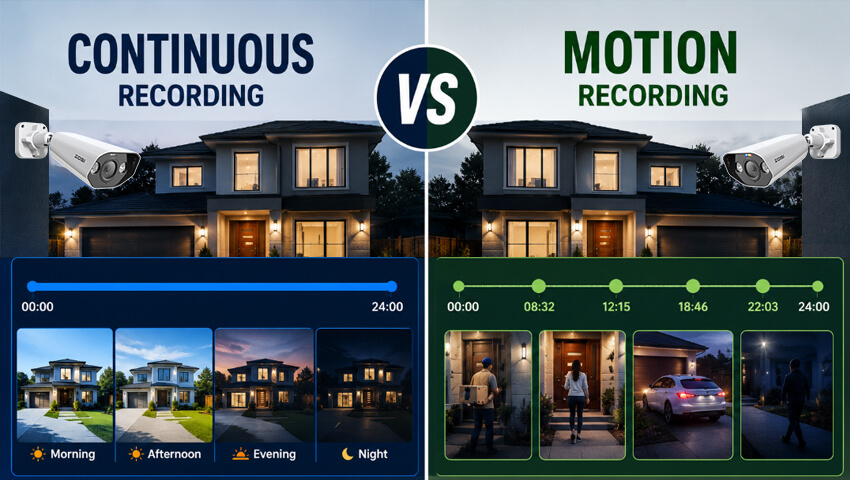
Continuous recording provides uninterrupted 24/7 surveillance, capturing every moment without gaps. This makes it more reliable for environments where missing any detail is not acceptable, such as retail stores, warehouses, or critical entry points. However, it requires significantly more storage and higher system resources, which can increase overall costs and maintenance needs.
Motion detection recording, on the other hand, only activates when movement is detected. This makes it far more storage-efficient and easier to manage during playback, since footage is organized around actual events. It is well-suited for homes, driveways, and low-traffic areas where constant recording is not necessary.
In short, continuous recording focuses on complete coverage, while motion detection prioritizes efficiency and event-based monitoring.
When to Use Continuous Recording
Continuous recording is recommended when you need complete surveillance coverage. Some common scenarios include:
– Business Settings: Retail stores, warehouses, offices, and locations with high-value assets benefit from uninterrupted footage.
– Critical Security Areas: Areas such as entrances, loading docks, or production floors where missing an event could have serious consequences.
– Detailed Investigations: When reviewing incidents for insurance, law enforcement, or internal audits, continuous footage ensures no gaps in the record.
When to Use Motion Detection Recording
Motion detection recording works best when storage efficiency and event-focused monitoring are priorities. Typical scenarios include:
– Home Security: Front doors, backyards, driveways, or garages where monitoring for visitors, deliveries, or intruders is the main goal.
– Battery-Powered Systems: Cameras with limited energy supply benefit from event-triggered recording.
– Cloud-Limited Systems: Reduces upload frequency, saving bandwidth and cloud costs.
By customizing sensitivity and detection zones, motion detection can provide reliable monitoring without excessive storage use.
Hybrid Recording Modes in Modern Security Systems
Many modern security cameras now offer hybrid recording modes, which combine continuous recording with motion tagging. Key features include:
– Continuous + Event Marking: The camera records 24/7 but highlights motion events for faster review.
– AI-Powered Alerts: Human or vehicle detection reduces false triggers while retaining full coverage.
– Smart Scheduling: Cameras can switch modes automatically, recording continuously during high-risk hours and motion-triggered during low-traffic periods.
Hybrid systems are increasingly popular because they provide a balance of thorough coverage and storage efficiency.
Storage Requirements and System Considerations
1. Continuous Recording
Requires larger storage, especially with multiple high-resolution cameras.
Example: Four 4K cameras recording 24/7 may need 8–10 TB per month.
HDD, NVR, or cloud storage planning is essential.
2. Motion Detection Recording
Significantly reduces storage needs.
AI compression (H.265/H.265+) can further optimize usage.
Cloud subscriptions may be more affordable due to fewer recorded hours.
System setup should always account for camera resolution, recording length, number of devices, and retention period.
AI Detection and Smart Features
Modern security cameras increasingly use AI to improve motion detection reliability:
– Human and Vehicle Detection: Differentiates between people, vehicles, pets, or other moving objects.
– False Alert Reduction: Filters out irrelevant movements like wind-blown branches or shadows.
– Event Categorization: Footage is automatically labeled, allowing users to quickly find the event type they are looking for.
These features make motion detection recording more reliable and reduce the need for constant monitoring.
Practical Use Cases
1. Home Entrances and Driveways: Motion-triggered alerts notify homeowners when someone approaches, while hybrid systems can store full coverage for investigations.
2. Small Businesses and Storefronts: Continuous recording ensures evidence in case of theft, while AI tagging speeds up review.
3. Garages and Storage Areas: Monitoring valuable tools and equipment with motion alerts minimizes storage while maintaining security.
4. Rental Properties and Airbnb: Motion detection reduces unnecessary footage, but continuous recording during check-in/check-out periods provides full event coverage.
Optimizing Your Recording Settings
To make the most of your chosen mode:
– Adjust Motion Sensitivity: Prevent false alerts while ensuring real threats are captured.
– Set Detection Zones: Focus only on critical areas to improve accuracy and efficiency.
– Use Scheduling: Record continuously only during certain hours if full-time coverage isn’t needed.
– Manage Storage Regularly: Delete outdated footage or archive important events to prevent running out of space.
Proper configuration ensures your system works efficiently while capturing the footage you need.
Conclusion
Choosing between continuous and motion detection recording comes down to balancing security coverage, storage management, and monitoring convenience.
Continuous Recording: Ideal for high-risk areas where no event can be missed.
Motion Detection Recording: Suitable for event-focused monitoring, saving storage, and battery life.
Hybrid Systems: Offer flexibility, combining the advantages of both modes for modern security needs.
By understanding your environment, security requirements, and storage capabilities, you can select the recording mode—or combination—that fits your needs. With the right setup, your cameras can provide reliable protection, efficient storage use, and peace of mind.
Related Security Guides
- How AI Human Detection Works in Surveillance Cameras
- How to Choose the Best Outdoor Security Camera for Your Home
- Why Solar Security Cameras Are Ideal for Driveway & Front Yard Protection
- How to Eliminate Blind Spots in Backyard Surveillance
- Security Camera Signage Rules: A Homeowner’s Complete Guide
Related Posts