Modern surveillance cameras are no longer just passive recording devices. With the integration of artificial intelligence (AI), they have become intelligent systems capable of analyzing scenes in real time. One of the most important features in today’s smart security systems is AI human detection. Instead of simply recording everything in view, these cameras can distinguish between humans, animals, vehicles, and irrelevant motion such as moving trees or lighting changes. This significantly improves security accuracy while reducing false alarms.
In this blog, we will explore how AI human detection works in surveillance cameras, the core technologies behind it, and why it has become a key feature in modern security systems.
Contents
What Is AI Human Detection?
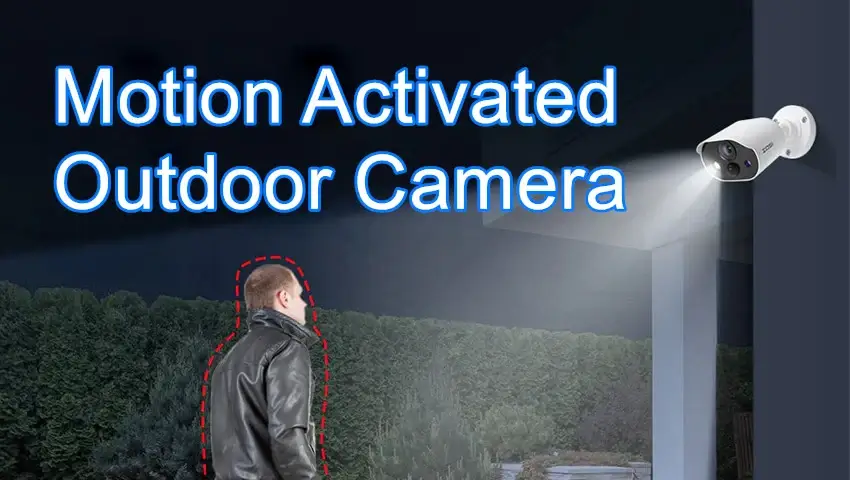
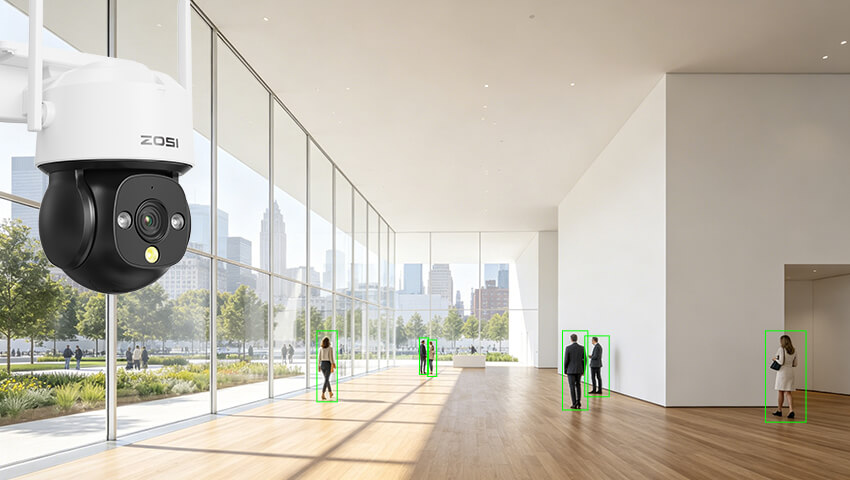
AI human detection is a technology that enables surveillance cameras to identify whether a moving object in their field of view is a human being. Unlike traditional motion detection systems that trigger alerts based on any movement, AI-based systems analyze shapes, patterns, and behaviors to determine what is actually causing the motion.
This means the system can ignore non-human triggers such as pets, shadows, rain, or swaying branches, and focus only on relevant security events involving people.
How AI Human Detection Works
AI human detection is powered by a combination of computer vision, machine learning, and deep learning algorithms. The process typically involves several steps:
1. Image Capture
The surveillance camera continuously captures video frames. Each frame is essentially a digital image made up of pixels. These frames are then sent to an onboard processor or cloud-based AI system for analysis.
2. Motion Detection (Initial Filtering)
Before applying heavy AI analysis, many systems first perform basic motion detection. This step identifies areas in the frame where changes occur. It helps reduce the workload by focusing only on regions with movement.
However, motion detection alone is not enough to identify humans—it only indicates that something is moving in the scene.
3. Object Detection Using AI Models
This is the core of human detection. The system uses trained deep learning models, often convolutional neural networks (CNNs), to analyze shapes and features within the moving region.
The AI model has been trained on millions of images containing humans in different positions, lighting conditions, and environments. As a result, it learns to recognize patterns such as:
- Head and shoulder structure
- Human body proportions
- Limb movement patterns
- Standing or walking posture
When a moving object matches these learned features, the system classifies it as a “human.”
4. Classification and Filtering
After detection, the system classifies the object into different categories such as:
- Human
- Vehicle
- Animal
- Unknown object
If the object is identified as a human, the camera triggers specific actions such as sending alerts, recording high-priority footage, or activating tracking features.
This filtering process is essential for reducing false alarms. For example, traditional cameras might trigger alerts when a cat walks by or when shadows move across the ground, but AI-powered systems ignore these irrelevant events.
5. Real-Time Alerts and Smart Response
Once a human is detected and classified, the system can trigger real-time actions such as:
- Sending push notifications to a smartphone
- Activating sirens or lights
- Uploading footage to cloud storage
- Enabling live streaming access
Some systems also integrate with smart home devices, allowing automated responses like turning on outdoor lights or locking doors.
Technologies Behind AI Human Detection
Several core technologies make AI human detection possible:
Deep Learning
Deep learning models are trained using large datasets of labeled images and videos. These models learn to recognize complex visual patterns that traditional algorithms cannot detect.
Edge Computing
Many modern cameras perform AI processing directly on the device instead of sending data to the cloud. This reduces latency and improves privacy.
Computer Vision
Computer vision allows machines to interpret visual information from video frames, including shape recognition, object tracking, and scene understanding.
Infrared and Low-Light Sensors
To improve accuracy at night, many cameras use infrared (IR) sensors combined with AI models, ensuring human detection works even in low-light conditions.
Benefits of AI Human Detection in Surveillance Cameras
AI human detection provides several important advantages:
1. Reduced False Alarms
One of the biggest problems with traditional surveillance systems is false alerts. AI significantly reduces unnecessary notifications caused by irrelevant motion.
2. Faster Response Time
Since the system identifies humans in real time, it can instantly alert users to potential security threats.
3. Improved Security Accuracy
AI focuses on meaningful events, ensuring that important incidents are not missed.
4. Smarter Monitoring
Instead of continuously watching live footage, users can rely on AI notifications and only review relevant events.
5. Energy and Storage Efficiency
By filtering out unnecessary recordings, AI reduces storage usage and processing load.
Challenges and Limitations
Despite its advantages, AI human detection is not perfect. Some challenges include:
- Misidentification in extreme lighting conditions
- Difficulty recognizing partially visible humans
- Occasional confusion with human-shaped objects (e.g., statues or posters)
- Dependence on training data quality
However, continuous improvements in AI models are rapidly reducing these limitations.
The Future of AI in Surveillance
The future of surveillance cameras is moving toward more intelligent and efficient systems. We can expect:
- More accurate multi-object recognition
- Better integration with smart home ecosystems
- Improved low-light and night detection
- Enhanced privacy protection using on-device AI
Eventually, surveillance systems will not just detect humans but will become more context-aware, helping users understand security situations more clearly.
Conclusion
AI human detection has transformed surveillance cameras from simple recording devices into intelligent security systems. By combining deep learning, computer vision, and real-time processing, these cameras can accurately identify human activity while ignoring irrelevant motion.
As technology continues to evolve, AI-powered surveillance will become even more accurate, efficient, and widely used in homes, businesses, and public spaces.
Related Posts