Contents
Why Summer Is a Critical Season for Security Systems
Summer is often assumed to be an “easy” season for security cameras because of longer daylight hours and better visibility. In reality, it is one of the most demanding environments for surveillance equipment.
Security cameras are exposed to multiple simultaneous stress factors:
- Prolonged high temperatures and direct solar radiation
- Rapid temperature shifts between day and night
- High humidity and sudden summer storms
- Increased environmental debris such as dust, pollen, and insects
- Higher motion activity due to outdoor living and travel season
These conditions do not usually cause immediate failure. Instead, they gradually affect system stability, image quality, and long-term hardware durability.
Understanding these seasonal risks is the first step in maintaining consistent performance throughout the summer.
Thermal Management and Heat Exposure Control
Heat is the most significant environmental stressor for outdoor security cameras.
How heat impacts camera components
When internal temperatures rise, several key components are affected:
- Image sensors may produce increased noise, reducing clarity
- Infrared LEDs can lose efficiency, weakening night vision performance
- Processing chips may throttle performance, causing reduced frame rates
- Long-term thermal stress can accelerate component aging
- Installation strategies for heat reduction
Proper placement is the most effective way to control temperature exposure:
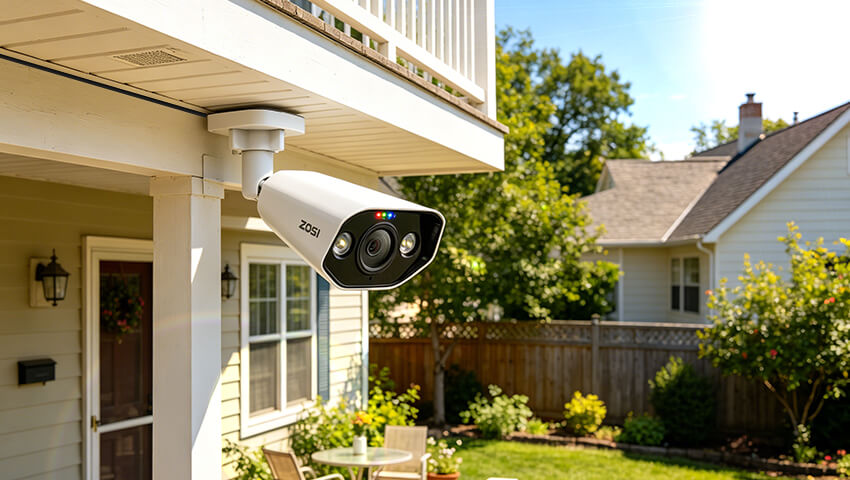
- Install cameras under eaves, roof overhangs, or shaded structures
- Avoid direct south-facing exposure in high-sun regions when possible
- Keep cameras away from reflective surfaces such as metal roofs or light-colored concrete walls
- Maintain airflow behind the mounting base whenever possible
Even partial shading can significantly reduce thermal load and improve long-term stability.
Additional engineering consideration
Where direct sun exposure is unavoidable, slightly downward camera angling reduces both sensor heating and optical flare interference.
Weather Resistance and Moisture Protection
Summer weather conditions often alternate between dry heat and sudden heavy rainfall, creating challenging moisture cycles.
Key risks include:
- Water intrusion through cable entry points
- Condensation caused by temperature fluctuations
- Degradation of rubber seals under prolonged heat exposure
- Wind-driven rain entering poorly protected joints
- Practical waterproofing measures
Even weatherproof-rated cameras require correct installation practices:
- Ensure all outdoor cables include proper drip loops
- Seal wall penetrations with silicone or weatherproof grommets
- Position connectors facing downward to prevent water accumulation
- Inspect mounting points and seals at least once per season
Ingress protection ratings such as IP66 or IP67 indicate resistance under controlled testing conditions, but long-term field performance depends heavily on installation quality.
Power Stability and Heat-Related Electrical Stress
Power delivery systems are often overlooked during seasonal maintenance, yet they are a common source of summer failures.
Heat-related power issues include:
- Power adapter overheating and voltage instability
- Increased electrical resistance in long cable runs
- Battery degradation or swelling in extreme heat conditions
- Power interruptions caused by thermal shutdown of components
- System-specific considerations
Wired DC systems require careful placement of adapters in shaded and ventilated areas.
Power over Ethernet systems provide improved stability by centralizing power delivery and reducing exposure of individual power adapters.
Solar-powered systems are effective in summer conditions but require careful battery placement to avoid direct heat exposure.
Network Performance and Connectivity Stability
Summer often leads to increased network congestion due to higher household activity, guest usage, and simultaneous streaming devices.
Common connectivity challenges:
Reduced WiFi bandwidth during peak usage hours
Signal interference from additional household devices
Physical obstructions affecting outdoor signal coverage
Latency issues impacting real-time monitoring and alerts
Optimization strategies
- Position routers in central, elevated locations
- Separate security cameras onto dedicated WiFi bands where possible
- Use mesh networking systems to eliminate coverage gaps
- Consider 4G or LTE-enabled cameras for remote or unstable network environments
Stable connectivity is essential for reliable motion alerts and uninterrupted remote access.
Storage Management During High Activity Periods
Summer typically increases recorded motion events significantly due to outdoor activity, resulting in higher storage consumption.
Contributing factors:
- Increased human presence in outdoor areas
- Movement from vegetation and environmental elements
- Longer daylight hours extending recording activity
- Higher resolution footage generating larger file sizes
Efficient storage practices
Configure motion-based recording in low-priority zones
Reserve continuous recording for critical entry points
Use modern compression formats such as H.265 to reduce storage load
Implement loop recording with priority backup for important footage
A balanced storage strategy ensures both coverage and efficiency without risking data loss.
Lens Maintenance and Optical Performance
Environmental particles accumulate more rapidly in summer due to dry air, pollen, and insect activity.
Common causes of image degradation:
Dust accumulation on lens surfaces
Pollen film reducing contrast and sharpness
Insect residue near infrared emitters
Spider web interference affecting motion detection accuracy
Maintenance recommendations
Clean lenses using a dry microfiber cloth every two to four weeks
Avoid chemical cleaners that may damage lens coatings
Inspect infrared LED areas for obstruction
Perform cleaning more frequently in high-exposure environments such as farms or gardens
Regular optical maintenance directly improves detection accuracy and image clarity.
AI-Driven Optimization for Summer Conditions
Modern security systems increasingly rely on artificial intelligence to manage environmental complexity.
Key AI functions include:
Human and vehicle detection to reduce false alarms
Motion filtering to ignore irrelevant environmental movement
Zone-based detection to focus on critical areas only
Adaptive sensitivity adjustments based on environmental activity
Seasonal tuning recommendation
During peak summer activity, slightly reduced sensitivity settings can help minimize false triggers caused by vegetation movement or insects while maintaining accurate event detection.
System Integration and Operational Stability
System-wide stability becomes increasingly important when environmental stress increases.
Integrated ecosystems, such as those developed by ZOSI, provide advantages including:
Centralized device management across multiple cameras
Unified firmware and security updates
Consistent AI detection behavior across devices
Simplified storage and playback management
A unified system reduces the risk of inconsistent performance across different components and improves long-term reliability.
Summer Maintenance Checklist
A structured maintenance routine ensures consistent system performance throughout the season.
Monthly inspection tasks:
Check lens clarity and clean if necessary
Inspect cable integrity and mounting stability
Verify network signal strength and stability
Review storage usage and recording efficiency
Seasonal maintenance tasks:
Confirm all waterproof seals and junctions
Test power supply stability under load
Update firmware and security settings
Recalibrate motion detection and AI zones
FAQs
1. What temperature is too hot for security cameras?
Most outdoor security cameras are designed to operate in a wide temperature range, typically up to around 50°C or higher depending on the model. However, performance stability can begin to degrade at lower temperatures if the device is exposed to direct sunlight without ventilation.
2. How can I protect my outdoor cameras from rain damage?
Ensure all cable connections are properly sealed, use drip loops to prevent water intrusion, and position connectors facing downward. Even weatherproof cameras benefit from correct installation practices.
3. Why does my security camera disconnect more often in summer?
Summer network congestion, WiFi interference, and overheating of networking equipment can all contribute to instability. Using mesh WiFi systems or improving router placement can help improve connectivity.
4. What is the best placement for outdoor cameras in summer?
Shaded areas such as under roof eaves or covered structures are ideal. Avoid direct sunlight exposure and reflective surfaces that may increase heat buildup.
Conclusion
Summer introduces a combination of heat, environmental exposure, and increased system workload that tests the limits of any security camera system. While modern devices are designed for outdoor use, long-term reliability depends heavily on installation quality, environmental awareness, and routine maintenance.
A properly optimized system not only withstands summer conditions but maintains consistent performance throughout the season, ensuring uninterrupted protection when it matters most.