Security cameras have become an essential part of modern home and business protection. Whether you’re monitoring your front door, backyard, office, or warehouse, having the right detection technology can make a significant difference in how effectively your security system works.
When shopping for a security camera, you’ll often encounter two common detection technologies: Motion Detection and AI Human Detection. While both are designed to alert users when activity occurs, they operate in very different ways and provide different levels of accuracy.
Understanding the differences between these technologies can help you choose the right camera for your security needs. In this article, we’ll explain how motion detection and AI human detection work, compare their advantages and disadvantages, and discuss which option is best for your property.
Contents
What Is Motion Detection?
Motion detection is the traditional technology used in security cameras to identify movement within a camera’s field of view.
Most motion detection systems work by analyzing changes in pixels between video frames. When the camera detects a significant change in the image—such as movement across the screen—it triggers an event. This event may include recording video, sending a notification, activating an alarm, or turning on a spotlight.
How Motion Detection Works
A motion detection camera monitors the scene continuously. When anything moves within the monitored area, the camera identifies the change and responds according to the configured settings.
Examples of events that can trigger motion detection include:
· A person walking across the driveway
· A car passing by
· A pet running through the yard
· Tree branches moving in the wind
· Shadows changing due to sunlight
· Heavy rain or snow
Because traditional motion detection cannot distinguish between different types of movement, it treats all motion as potentially important.
Advantages of Motion Detection
Affordable Technology
Motion detection has been available for many years and is included in most entry-level security cameras.
Simple Setup
Most cameras enable motion detection by default, making it easy for users to start monitoring immediately.
Effective for General Surveillance
If your primary goal is simply to record activity whenever movement occurs, motion detection can be sufficient.
Limitations of Motion Detection
Frequent False Alerts
One of the biggest drawbacks is the high number of unnecessary notifications. Wind-blown leaves, insects, pets, or passing vehicles can all trigger alerts.
Notification Fatigue
When users receive too many irrelevant alerts, they may begin ignoring notifications altogether, potentially missing important events.
Limited Intelligence
Motion detection identifies movement but cannot determine what caused it.
What Is AI Human Detection?
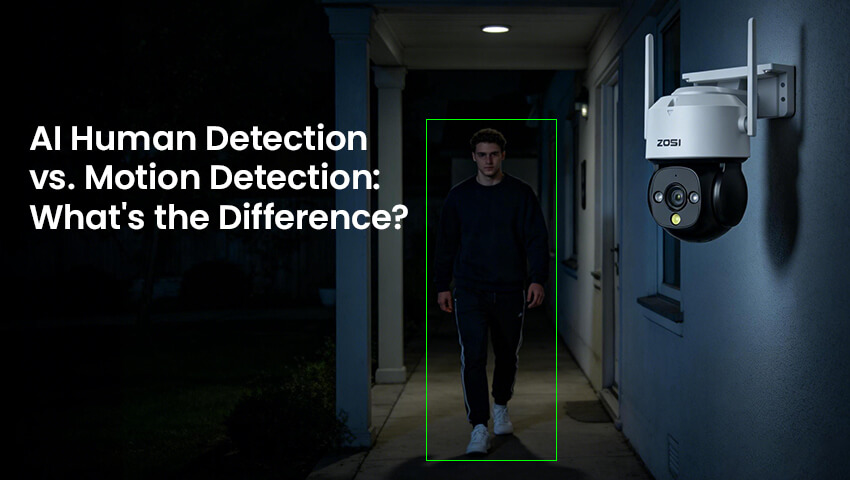
AI Human Detection is a more advanced technology that uses artificial intelligence and machine learning algorithms to identify whether the detected movement is actually caused by a person.
Instead of simply recognizing motion, AI-powered cameras analyze shapes, body structures, movement patterns, and other visual characteristics to determine if a human is present.
How AI Human Detection Works
When motion occurs, the camera’s AI processor examines the object responsible for the movement.
The system compares the object’s characteristics against trained recognition models. If the object matches human features, the camera classifies it as a person and triggers an alert.
If the movement is caused by a vehicle, animal, tree branch, or other non-human object, the camera may ignore the event or categorize it differently, depending on its capabilities.
Many modern security cameras can also support:
· Human Detection
· Vehicle Detection
· Pet Detection
· Package Detection
· Face Recognition (on certain models)
This intelligent analysis allows cameras to deliver more accurate and relevant alerts.
Advantages of AI Human Detection
Fewer False Alarms
AI significantly reduces unnecessary notifications caused by environmental movement.
More Relevant Alerts
Users receive alerts primarily when a person is detected, making notifications more meaningful.
Improved Security Awareness
Because alerts are more accurate, homeowners and business owners can respond more quickly to potential security threats.
Better Video Management
Users spend less time reviewing footage because the camera highlights events involving actual people.
Limitations of AI Human Detection
Higher Cost
AI-powered cameras are generally more expensive than basic motion detection models.
Processing Requirements
Advanced AI functions require more computing power, either within the camera itself or through cloud-based processing.
Potential Recognition Errors
Although AI technology has improved dramatically, no system is perfect. Under challenging conditions such as poor lighting, extreme weather, or partially obstructed views, occasional misclassification may occur.
AI Human Detection vs. Motion Detection: Key Differences
The fundamental difference is simple:
· Motion Detection asks, “Did something move?”
· AI Human Detection asks, “Was that movement caused by a person?”
This additional layer of intelligence makes AI-based systems far more practical for modern security applications.
Which Technology Is Better for Home Security?
For most homeowners, AI Human Detection is the superior choice.
Front doors, driveways, backyards, and garages often experience constant environmental movement. Traditional motion detection may generate dozens of unnecessary notifications each day.
AI Human Detection helps eliminate this problem by focusing on people rather than general motion. For example:
· A delivery person approaching your door triggers an alert.
· A neighbor walking onto your property triggers an alert.
· A tree branch swaying in the wind does not trigger an alert.
· A cat crossing the yard may be ignored.
This improved accuracy creates a more efficient and user-friendly security experience.
Which Technology Is Better for Businesses?
Businesses can benefit even more from AI Human Detection.
Commercial properties often have large areas to monitor, including parking lots, entrances, warehouses, and office spaces.
Security teams need actionable information rather than constant notifications caused by vehicles, weather conditions, or background activity.
AI-powered cameras can help:
· Monitor employee access points
· Detect unauthorized visitors
· Reduce false security incidents
· Improve investigation efficiency
· Enhance overall situational awareness
For business environments where security is critical, AI Human Detection provides a significant advantage.
The Future of Smart Security Cameras
As artificial intelligence continues to evolve, security cameras are becoming increasingly intelligent.
Today’s AI cameras can already distinguish between people, vehicles, pets, and packages. Future developments are expected to provide even more advanced capabilities, including behavior analysis, threat assessment, and smarter automation.
These innovations will help users receive faster, more accurate information while reducing unnecessary alerts and manual monitoring.
FAQs
1. Is AI human detection better than motion detection?
For most home and business security applications, AI human detection is more effective because it can distinguish people from irrelevant movement such as pets, shadows, or moving branches. However, basic motion detection can still be useful for general activity monitoring.
2. Can motion detection detect people?
Yes. Motion detection can detect movement caused by people, but it cannot reliably determine whether the movement comes from a person or another moving object. This is the key difference between basic motion detection and AI human detection.
3. Can AI security cameras detect vehicles and pets too?
Yes. Depending on the model, AI security cameras may support additional detection categories such as vehicles, pets, packages, or faces. These features allow users to customize alerts based on the type of activity they want to monitor.
4. Should I use motion detection and AI human detection together?
Yes. Many modern security cameras use motion detection as an initial trigger and then apply AI analysis to identify the type of object involved. This combination can provide broader activity monitoring while keeping alerts more relevant.
Conclusion
Both Motion Detection and AI Human Detection play important roles in modern security systems, but they offer very different levels of intelligence.
Motion Detection is a reliable and cost-effective solution for basic surveillance, but it often generates excessive false alerts because it reacts to any type of movement.
AI Human Detection goes a step further by identifying whether the detected motion is caused by a person. This results in more accurate notifications, improved security awareness, and a better overall user experience.
For homeowners and businesses seeking smarter, more efficient protection, AI Human Detection has become one of the most valuable features available in today’s security cameras. By reducing unnecessary alerts and focusing on genuine human activity, it helps users stay informed about what truly matters.