Contents
Introduction
In today’s connected world, a strong WiFi network is no longer a luxury—it’s a necessity. From working remotely and streaming movies to gaming online and controlling smart home devices, reliable WiFi is essential for every household. Yet, many homes struggle with WiFi dead zones, slow speeds, and dropped connections.
To solve these issues, two popular solutions stand out: WiFi extenders and Mesh WiFi systems. But which one is right for your home? In this article, we’ll break down the differences between WiFi extenders and mesh WiFi, explore their pros and cons, and help you decide the best solution for your living space.
What Is a WiFi Extender?
A WiFi extender, also known as a repeater, is a device that amplifies and retransmits your existing WiFi signal. It’s designed to cover specific dead zones in your home, like a far corner bedroom or basement, where the router’s signal is weak.
How WiFi Extenders Work
WiFi extenders pick up the signal from your main router and rebroadcast it, effectively extending the coverage. Some extenders require you to connect via Ethernet for better performance, while others work entirely wirelessly.
Pros of WiFi Extenders
— Affordable: Most extenders are budget-friendly, making them a great option for small homes.
— Easy to Install: Usually plug-and-play with simple setup steps.
— Targeted Coverage: Focuses on problem areas, improving signal strength in specific locations.
Cons of WiFi Extenders
— Reduced Speed: Wireless extenders can cut your WiFi speed in half due to the signal rebroadcasting process.
— Limited Coverage: Works well for small areas but may struggle with large homes or multiple floors.
— Separate Network Names: Some extenders create a secondary network, which can require manually switching devices.
What Is a Mesh WiFi System?
Mesh WiFi systems are designed to provide seamless coverage across large homes or multiple floors. Instead of relying on a single router, mesh systems use multiple nodes or satellites that communicate with each other to create one unified network.
How Mesh WiFi Works
A mesh system has a main router connected to your modem and several nodes placed strategically throughout your home. These nodes automatically route traffic and hand off devices as you move from room to room, maintaining a strong signal everywhere.
Pros of Mesh WiFi
— Seamless Coverage: No dead zones, even in large homes.
— Consistent Speed: Maintains faster speeds than extenders because nodes communicate efficiently.
— Easy Network Management: Most mesh systems come with user-friendly apps to monitor devices and manage settings.
— Supports Multiple Devices: Handles high bandwidth for smart homes, gaming, and streaming.
Cons of Mesh WiFi
— Higher Cost: Mesh systems are more expensive than extenders.
— More Complex Setup: While apps simplify the process, it’s slightly more involved than plugging in a single extender.
WiFi Extender vs. Mesh WiFi: Key Differences
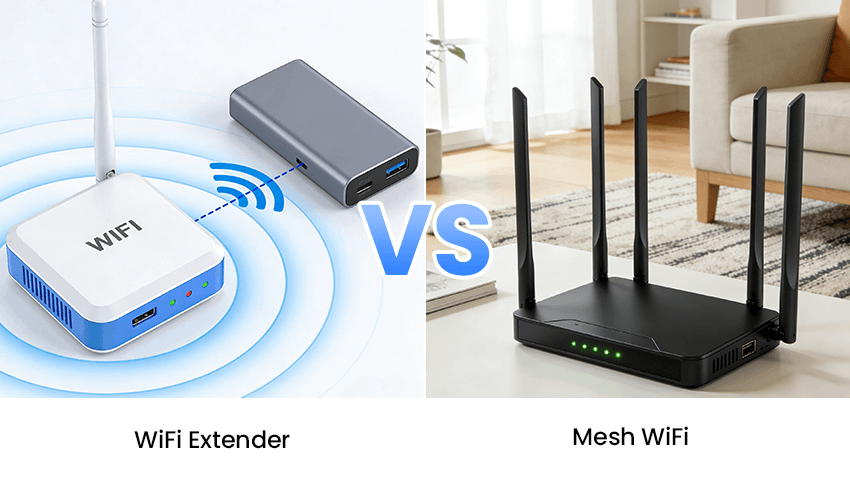
When comparing WiFi extenders and mesh WiFi systems, the first thing to consider is coverage. WiFi extenders provide limited coverage and are mainly effective at eliminating dead zones, whereas mesh WiFi systems are designed to deliver seamless coverage across large homes and multiple floors.
Another major difference is speed and performance. Extenders can sometimes reduce the WiFi speed because they rebroadcast the signal, while mesh networks maintain consistent high speeds throughout the home, even with multiple devices connected.
Network management is also different between the two. WiFi extenders often create a separate network name, which may require you to manually switch between networks as you move through your home. On the other hand, mesh systems offer a single, unified network, allowing your devices to connect automatically without interruptions.
Setup complexity is another consideration. Extenders are usually simple plug-and-play devices, making them easy to install. Mesh systems are slightly more involved to set up, but most modern systems come with intuitive apps that guide you through the process step by step.
Finally, the ideal use case differs. WiFi extenders are best suited for small apartments or budget-conscious users who need targeted coverage for one or two areas. Mesh WiFi systems, however, are perfect for larger homes, households with multiple devices, or situations where high-demand internet usage is required, such as streaming, gaming, or running a smart home.
When to Choose a WiFi Extender
WiFi extenders are ideal if:
– You live in a small home or apartment and only have minor dead zones.
– You’re on a tight budget and need a quick solution.
– You want to improve coverage in one or two specific areas, like a home office or basement.
Extenders are simple and affordable, making them a popular choice for casual users who don’t need ultra-fast speeds in every corner.
When to Choose a Mesh WiFi System
A mesh WiFi system is worth the investment if:
– You have a large home with multiple floors.
– You use multiple smart devices, stream 4K content, or game online frequently.
– You want seamless WiFi without manually switching networks.
Mesh systems provide a future-proof solution, ensuring reliable coverage as more devices are added to your home network.
Tips for Optimizing Home WiFi
Even with extenders or mesh systems, optimizing placement and setup is key:
1. Router Placement
Place your main router in a central location, away from walls and obstructions.
Avoid corners or closets that block signal.
2.Extender Placement
Place extenders halfway between the router and dead zone.
Avoid placing near large metal objects or microwaves.
3.Mesh Node Placement
Space nodes evenly throughout your home for maximum coverage.
Keep nodes within range of each other to avoid weak links.
4.Use 2.4GHz vs. 5GHz Bands
2.4GHz covers longer distances but is slower.
5GHz is faster but shorter range—ideal for streaming and gaming.
5.Regular Firmware Updates
Keep all devices updated for improved performance and security.
Common Myths and Misconceptions
“Extenders always slow down WiFi” – Wireless extenders may reduce speed slightly, but Ethernet-connected extenders maintain performance.
“Mesh is only for tech-savvy users” – Modern mesh systems are app-driven and user-friendly.
“One solution fits all homes” – The best solution depends on home size, layout, and device usage.
Conclusion
Both WiFi extenders and mesh WiFi systems have their place. Extenders are a budget-friendly solution for small homes or isolated dead zones, while mesh WiFi is the ideal choice for larger homes or households with multiple devices and high-bandwidth needs.
By assessing your home layout, internet usage, and budget, you can choose the best system to boost your home WiFi, eliminate dead zones, and enjoy seamless connectivity for work, entertainment, and smart home devices.
Related Posts