
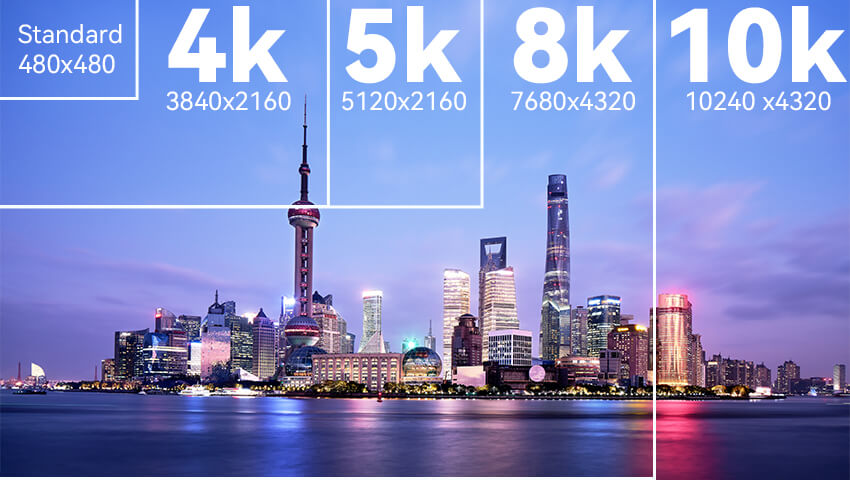
When choosing a security camera system, camera resolutionis one of the most important factors to consider. Higher resolution means clearer images, better digital zoom, and more reliable evidence capture. In today’s market, resolutions from 4K to 10K are becoming increasingly popular as people demand greater detail and accuracy in surveillance footage.
In this guide, we’ll break down the differences between 4K, 5K, 8K, and 10Kcamera resolutions and help you decide which one is right for your security needs.
Contents
What Is Camera Resolution?
Camera resolution refers to the number of pixels a camera can capture. More pixels = sharper, clearer, and more detailed video.
4K Resolution (3840 × 2160)
4K, also known as Ultra HD, is currently the most widely used high-end resolution in modern security systems.
Advantages of 4K Cameras
Clear facial recognition at medium distance
Excellent for identifying license plates
Works well for wide coverage areas
Supported by most NVRs and mobile apps
Best for:
Homes, small businesses, retail stores, offices
5K Resolution (5120 × 2880)
5K cameras offer about 77% more pixels than 4K, providing a noticeable improvement for zooming in without losing detail.
Advantages of 5K Cameras
Better digital zoom clarity compared to 4K
Ideal for capturing fine details in large spaces
Slightly higher image quality for critical monitoring
Best for:
Warehouses, parking lots, large estates
8K Resolution (7680 × 4320)
8K is known as Ultra HD 8K, offering four times the resolution of 4K.
Advantages of 8K Cameras
Extremely sharp image quality
Precise detail even when zooming in significantly
Excellent for long-distance monitoring
Challenges:
Requires large storage capacity
Needs powerful NVRs and network bandwidth
Higher cost
Best for:
Airports, casinos, large shopping malls, high-security environments
10K Resolution (approx. 10328 × 7760)
10K cameras are ultra-premium and still emerging in the security industry.
What Makes 10K Unique?
Unmatched clarity for extremely large surveillance areas
Allows deep forensic zooming while maintaining detail
Provides future-proof video quality as technology advances
Challenges:
Very high cost
Requires top-tier storage and processing power
Limited availability
Best for:
Government facilities, stadiums, city-wide surveillance, large commercial operations
Which Resolution Should You Choose?
| Resolution | Best Use Case | Key Benefit | Considerations |
| ———- | ————————- | ————————- | ———————————— |
| 4K | Home & business | Great clarity, affordable | Standard for most users |
| 5K | Large areas | Better zoom than 4K | Higher storage needs |
| 8K | High-security sites | Extremely sharp | Expensive and demanding |
| 10K | Professional surveillance | Maximum detail | Not cost-effective for typical users |
Final Thoughts
Choosing the right camera resolution depends on your environment, security requirements, and budget. For most homeowners and small businesses, 4K provides exceptional clarity at an affordable price. For high-security or large-scale operations, 8K and 10K offer unmatched detail—but come with significant hardware demands.
As technology evolves, ultra-high-resolution cameras will become more accessible, bringing sharper, smarter, and more reliable surveillance to everyone.
Related Posts
 What Is the Highest Resolution? Understanding Ultra HD Technology and Its Future
 Understanding PoE Pinout: The Backbone of Modern Security Camera Systems
 Understanding Security Camera Warranty: Why It Matters
 Modem vs Router vs Switch: Understanding the Core of Your Security Camera Network
 Solar Powered Security Camera Complete Guide