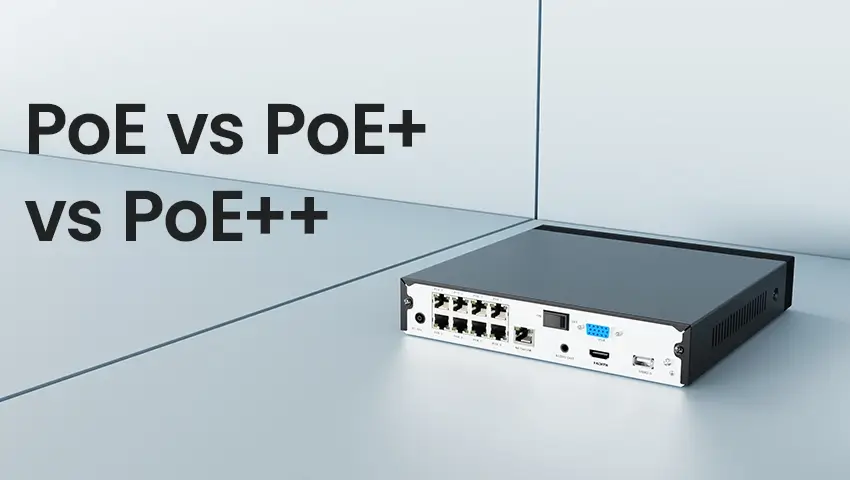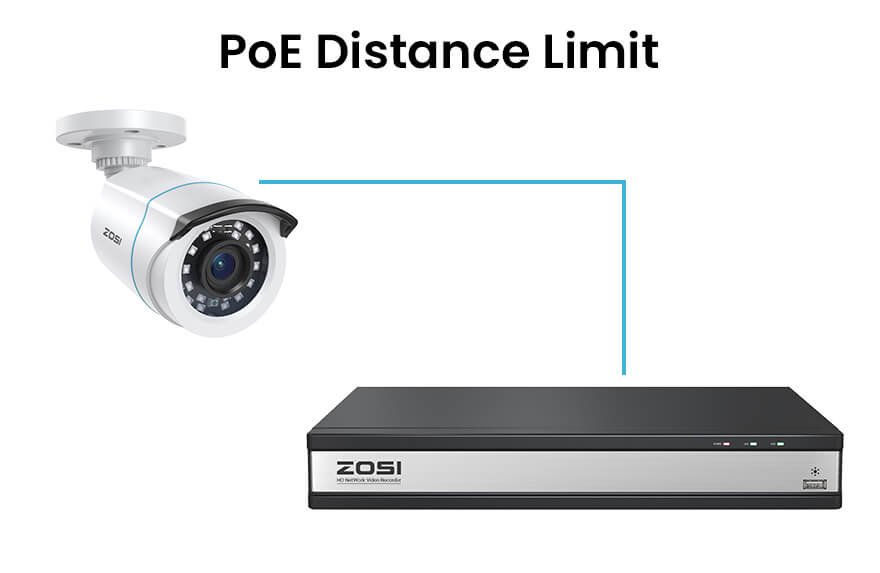
Power over Ethernet (PoE) has become a popular solution for a wide range of networked devices. With a single Ethernet cable delivering both power and data, PoE simplifies installation and improves reliability for devices such as cameras, phones, sensors, access points, and intercoms.
Understanding the PoE distance limit is essential when planning device placement—especially in large homes, offices, warehouses, or outdoor areas. In this article, we’ll explain what the PoE distance limit is, why it exists, and how to design a stable PoE system without signal or power issues.
Contents
Common PoE Standards and PoE Distance Limit
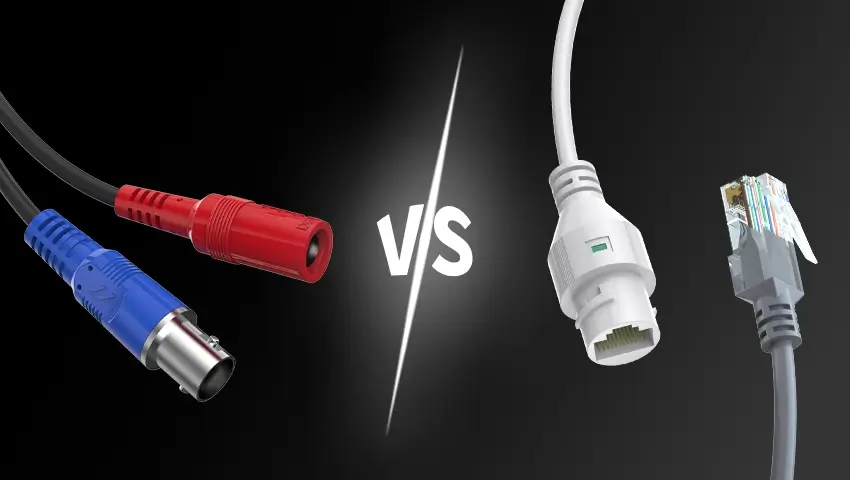
PoE allows electrical power and network data to be transmitted together through a standard Ethernet cable (such as Cat5e or Cat6). For networked devices, this means:
• No separate power adapter
• Fewer cables and cleaner installation
• More stable performance than wireless in many environments
Common PoE Standards
Different IEEE standards define how much power PoE devices can deliver:
• 802.3af (PoE): Up to 15.4W per port
• 802.3at (PoE+): Up to 30W per port
• 802.3bt (PoE++): Up to 60–90W per port
While power capacity varies, the *distance limit* remains largely the same across standards.
The Standard PoE Distance Limit
Why Is PoE Limited to 100 Meters?
The maximum standard PoE transmission distance is 100 meters (328 feet). This includes:
• Up to 90 meters of solid Ethernet cable
• Up to 10 meters of patch cords
This limit comes from Ethernet data transmission rules, not just power delivery. As cable length increases, signal attenuation and electrical resistance increase, affecting both data integrity and voltage stability.
Even if power could theoretically travel farther, Ethernet data communication becomes unreliable beyond 100 meters.
PoE Distance Limitations by Ethernet Cable Type
Different Ethernet cables affect the achievable PoE distance:
Cat5e Cable
• Commonly used and supports up to 100 meters for all PoE standards
• Cable quality is important, especially for higher power devices
Cat6 Cable
• Higher bandwidth; supports up to 100 meters
• Typically uses thinner 24 AWG conductors; generally reliable for most installations
Cat6a Cable
• Uses thicker 23 AWG conductors, like Cat5e
• Lower DC resistance allows better power delivery over long runs, ideal for PoE++ devices
Cat7 Cable
• High bandwidth and shielding, but not commonly used for PoE
• Offers no significant practical advantage over Cat6a for longer PoE runs
Factors That Affect PoE Distance in Real-World Use
Several factors affect the effective PoE distance beyond the nominal 100 meters:
1. Cable Type and Quality
Cat5e: Meets basic PoE needs up to 100 m
Cat6 / Cat6a: Lower resistance, better for stable PoE performance
Cat7: Minimal voltage drop for long runs, rarely used in standard installs
2. Cable Material (Solid Copper vs CCA)
Solid copper:** Best for PoE; consistent resistance, stable voltage
CCA (copper-clad aluminum):** Higher resistance; reduces effective PoE distance and can cause instability on longer runs
3. Device Power Consumption
High-power devices (PTZ cameras, access points, video doorbells) draw more wattage and are more sensitive to voltage drop over long distances.
4. PoE Source Power
A PoE switch or injector with higher and more stable output can maintain operation closer to the maximum cable length.
5. Environmental Conditions
Extreme cold, heat, or moisture can increase resistance and impact cable performance, especially outdoors.
What Happens If You Exceed the PoE Distance Limit?
Running PoE beyond 100 meters can cause a range of issues:
• Voltage drop: The device may not receive enough power to operate properly
• Intermittent connection: Video feeds, calls, or sensors may freeze or disconnect
• Device rebooting: Devices may restart due to insufficient power
• Complete failure: Some devices may not power on at all
These problems often appear inconsistent, making them difficult to troubleshoot if the distance limit is not considered.
How to Extend PoE Distance for Devices
When device placement exceeds the standard 100‑meter PoE limit, extending the distance requires deliberate network design. The following methods are commonly used in professional deployments, each with its own advantages and use cases.
Use a PoE Switch or Midpoint Device
Adding a PoE switch or powered network device between the source and endpoint effectively resets the 100‑meter limit. This approach is widely used in office buildings and large homes, where a secondary switch can be installed in a garage, utility room, or intermediate building.
Add a PoE Extender or Repeater
PoE extenders regenerate both power and data without requiring a local power outlet. Each extender adds another 100‑meter segment. This solution is ideal for outdoor cameras, parking lots, or perimeter installations where power is unavailable.
Use Fiber Optic Cable for Long Runs
Fiber optic cable eliminates distance concerns for data transmission, supporting hundreds of meters or even kilometers. A typical setup uses fiber between buildings or distant locations, then converts back to Ethernet with a media converter or fiber switch, followed by a PoE switch near the device to supply power.
Long‑Range PoE Modes
Some PoE switches offer long‑range or extended modes that support distances of 200–250 meters. These modes often reduce network speed (for example, to 10 Mbps), which is usually sufficient for basic surveillance or sensor data but may not suit high‑bitrate applications.
Key planning tip: Extending distance should always consider total power budget, cable quality, and long‑term stability—not just maximum reach.
PoE Distance Limits for Different Device Applications
Although PoE standards define a uniform maximum distance, real‑world PoE performance varies significantly depending on the device type, power behavior, and workload. Understanding these differences helps avoid unstable installations.
Security Cameras
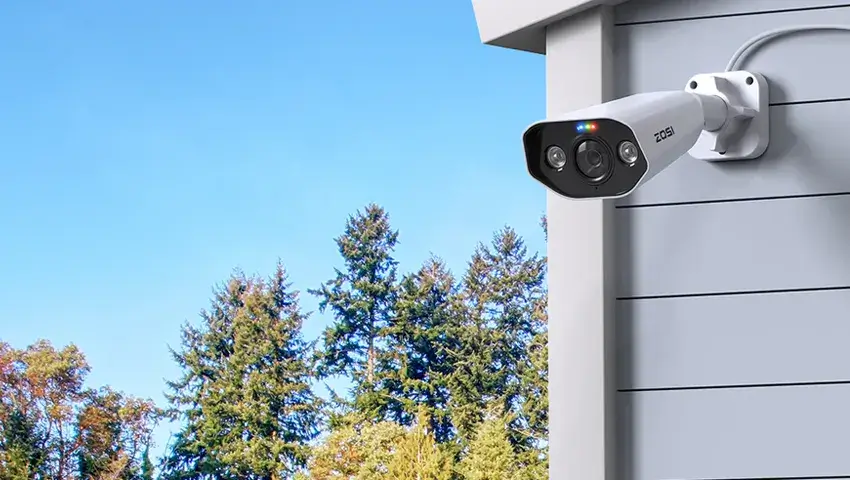
Security cameras are among the most demanding PoE devices. Fixed cameras with basic features typically operate reliably up to 100 meters. However, PTZ cameras, multi‑sensor models, or cameras with strong IR or true‑color night vision draw higher power—especially at night—making 70–90 meters a safer design range.
https://www.zositech.com/products/c186-4k-auroralux-true-color-night-vision-poe-camera?variant=48121068093682
For example, ZOSI’s C186 4K AuroraLux True Color Night Vision PoE Camera delivers full-color images in ultra-low-light conditions, which requires stronger illumination and image processing. In real-world deployments, cameras like this benefit from more conservative cable planning, making 70–90 meters a safer design range to ensure stable power delivery and consistent video performance, particularly during nighttime operation.
VoIP Phones
VoIP phones have low and predictable power consumption. Most models work reliably near the full 100‑meter limit, even on standard Cat5e cabling, making them one of the most distance‑tolerant PoE devices.
Sensors and IoT Devices
PoE sensors (motion, temperature, access control) consume very little power. They can usually operate close to the maximum distance, provided cable terminations are clean and of good quality.
Wireless Access Points (APs)
Modern APs often include multiple radios and high throughput, leading to variable power draw. For stable performance, especially with Wi‑Fi 6/6E, distances of 70–90 meters are recommended, particularly when powered by PoE+ or PoE++.
Video Doorbells and Intercoms
These devices generally have moderate power needs but may experience short power bursts during video streaming or two‑way audio. While they can approach 100 meters, voltage stability becomes critical, especially with thinner or lower‑quality cables.
PoE Network Devices (Mini Switches, Controllers)
PoE‑powered switches and controllers pass power downstream, increasing overall load. Because of this compounded power draw, shorter cable runs—often under 70 meters—are recommended for stable operation.
Key takeaway: Even within the 100‑meter standard, matching device type with appropriate distance, cable quality, and PoE standard is essential for long‑term reliability.
FAQs
Q1: Does a higher PoE standard (PoE+ or PoE++) increase the maximum distance?
No. Higher PoE standards increase the available power, not the transmission distance. Ethernet data communication is still limited to 100 meters. However, higher power can improve stability for power-hungry devices within that distance.
Q2: Can I exceed 100 meters if my camera or device still powers on?
While some devices may power on beyond 100 meters, performance is often unstable. You may experience intermittent disconnections, reboots, or degraded video quality, especially at night or under heavy load.
Q3: What is the best cable choice for long PoE runs?
Solid copper Cat6 or Cat6a cables are recommended for long or high-power PoE runs. They offer lower resistance and more stable voltage delivery compared to lower-grade or CCA cables.
Q4: Is PoE more reliable than WiFi for long-distance installations?
Yes. Within its distance limits, PoE provides a more stable and interference-free connection than WiFi. For distances beyond 100 meters, PoE can still be extended using switches, extenders, or fiber.
Conclusion
The 100-meter PoE distance limit is a key rule, but proper cable choice, device planning, and extensions allow reliable operation for most networked devices. Using solid copper, higher-grade cables, and considering device power draw ensures smooth operation and long-term system stability.