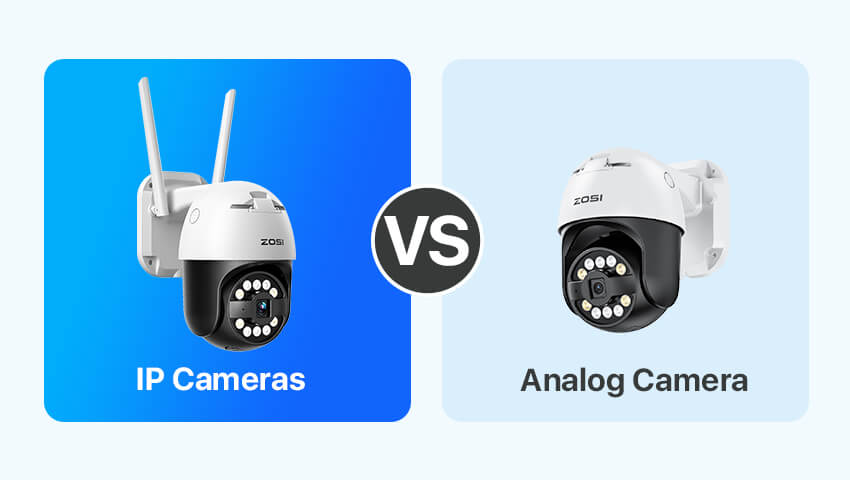
When planning a security system, one of the first—and most important—decisions is choosing between analog cameras and IP (Internet Protocol) cameras. Both technologies are widely used in video surveillance, and each has its own strengths depending on budget, installation environment, and monitoring needs.
This guide breaks down the differences in a clear and practical way, helping you choose the system that best fits your home or business.
Contents
What Are Analog Cameras?
How Analog Camera Systems Work
Analog cameras capture video and transmit it as an analog signal over coaxial cables to a DVR (Digital Video Recorder). The DVR converts the signal into digital data, compresses it, and stores it on a hard drive.
Modern analog systems are far more advanced than early CCTV setups and can support high-definition video.
Common Types of Analog Cameras
• CVBS – Traditional standard-definition analog
• AHD (Analog High Definition)
• TVI (Transport Video Interface)
• CVI (Composite Video Interface)
AHD, TVI, and CVI technologies allow analog systems to reach HD and even 4K resolutions while keeping installation simple.
What Are IP Cameras?
How IP Camera Systems Work
IP cameras capture video digitally from the start. Each camera has its own IP address and sends data over an Ethernet network or WiFi to an NVR (Network Video Recorder) or cloud/local storage.
With PoE (Power over Ethernet), a single network cable can provide both power and data, simplifying wiring.
Standalone vs NVR-Based IP Systems
• Standalone IP cameras: Work independently with apps or local storage
• NVR-based systems: Centralized recording and management, ideal for multi-camera setups
Analog vs IP Cameras: Key Differences
Video Quality & Image Detail
Analog cameras deliver reliable HD performance, commonly ranging from 1080p to 4K. However, image processing is handled by the DVR, which can limit fine detail in complex scenes. IP cameras process video digitally at the camera level, resulting in sharper images, better color accuracy, and improved performance in low-light environments.
Installation & Cabling
Analog systems require coaxial cables for video transmission and separate power cables. This setup is straightforward and well-suited for existing wiring. IP systems typically use Ethernet cables or WiFi. With PoE (Power over Ethernet), one single cable handles both power and data, reducing cable clutter and simplifying large installations.
System Scalability
Analog systems are restricted by the number of channels supported by the DVR. Expanding the system often requires replacing the DVR. IP systems are more flexible—new cameras can be added to the network with minimal changes, making them ideal for growing security needs.
Smart Detection & AI Capabilities
Analog cameras mainly rely on basic motion detection, with some intelligent functions processed at the DVR level. IP cameras support advanced AI features such as human and vehicle detection, line crossing, intrusion detection, loitering alerts, and intelligent event search, significantly reducing false alarms.
Remote Access & Monitoring
Remote viewing on analog systems depends on DVR network configuration. IP cameras are designed for seamless remote access through apps or web platforms, allowing real-time monitoring, playback, and alerts from anywhere.
Network & Bandwidth Requirements
Analog systems operate independently of network conditions. IP systems rely on stable network bandwidth, especially when streaming high-resolution video or multiple cameras simultaneously.
Security & Data Protection
Analog systems function as closed circuits, minimizing exposure to network threats. IP systems incorporate encryption, user authentication, and permission controls, offering strong data protection when properly configured.
Cost & Long-Term Value
Analog systems typically have a lower upfront cost and predictable maintenance. IP systems require higher initial investment but provide greater functionality, smarter features, and better long-term scalability.
Use-Case Scenarios: Which System Fits Best?
Home Users
For homes and apartments, the choice often comes down to budget and convenience. Analog systems are ideal for users who want dependable basic coverage—such as monitoring entrances, backyards, or garages—without complex setup. IP cameras, on the other hand, are better suited for smart homes. They integrate easily with mobile apps, support instant alerts, and allow homeowners to check live views or playback footage anytime, anywhere.
Small Businesses
Retail stores, offices, and cafés often need reliable monitoring with minimal maintenance. Analog systems work well in fixed layouts where camera positions rarely change and budgets are limited. IP systems are a stronger option for businesses that want intelligent alerts, people counting, or the ability to expand coverage as operations grow.
Large Properties & Enterprises
For warehouses, factories, campuses, or multi-building properties, scalability is critical. Analog systems become less practical due to DVR channel limits and cabling complexity. IP systems excel in these environments, offering centralized management, long-distance transmission, and advanced AI features that help security teams respond quickly and efficiently.
Remote & Multi-Location Monitoring
If remote access is a priority, IP cameras are clearly advantageous. They are designed for real-time remote viewing, event notifications, and centralized management across multiple locations. Analog systems can support remote access, but typically require additional configuration and hardware.
Analog vs IP: Pros and Cons Summary
Analog Cameras
Pros
Analog systems are cost-effective, easy to understand, and extremely stable. They operate independently of network conditions, making them a dependable choice for users who want straightforward surveillance with minimal technical requirements.
Cons
Their limitations include fewer smart features, reduced flexibility for system expansion, and less advanced search and alert functions compared to IP systems.
IP Cameras
Pros
IP systems deliver superior image clarity, powerful AI detection, and seamless remote access. They are highly scalable and adaptable, making them ideal for users who want a future-ready security solution.
Cons
The main trade-offs are higher upfront costs and dependence on network stability, particularly when running multiple high-resolution cameras.
How to Choose the Right System for Your Needs
Before making a decision, consider the following questions:
• How much image detail do I need for identification and evidence?
• Do I want smart detection features that reduce false alerts?
• Is my network stable enough to support multiple IP cameras?
• Will I need to expand the system in the future?
• What is my budget for both initial purchase and long-term use?
If simplicity, stability, and budget are your top priorities, an analog system may be the right fit. If flexibility, intelligence, and remote access matter more, an IP camera system is likely the better choice.
FAQs
Q1: Are analog cameras outdated?
No. Modern analog systems still offer reliable performance and high-definition video.
Q2: Do IP cameras always require the internet?
No. They can work on a local network with local storage, but internet access enables remote viewing.
Q3: Which system is easier to install?
Analog systems are simpler for basic setups, while PoE IP systems are efficient for larger installations.
Conclusion
Both analog and IP camera systems have their strengths, and the “right” choice often depends on how and where you use them. Some users prefer the simplicity and reliability of analog systems, while others enjoy the flexibility and smart features of IP cameras.
Now we’d love to hear from you:
• What type of camera system are you currently using—analog or IP?
• What made you choose it?
• Has your security setup changed over time?
Your experience may help others who are facing the same decision.
At ZOSI, we support both technologies because real security needs are diverse. Whether you’re upgrading an existing system or building a new one from scratch, understanding your own priorities is the first step toward smarter protection.