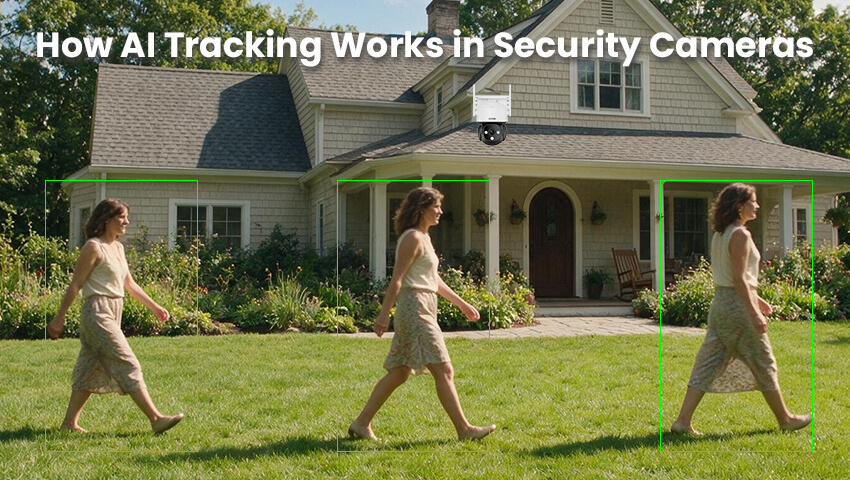
Security cameras have come a long way from simply recording everything that happens in front of a lens. Many modern cameras can now detect movement, identify different types of objects, and automatically follow a moving subject.
But how does AI tracking actually work?
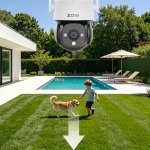
At a basic level, AI tracking combines motion detection, intelligent object recognition, and camera movement. When a compatible camera detects a moving subject, its software can determine what the subject is and, on cameras with pan-and-tilt capabilities, adjust the viewing angle to keep that subject in sight.
This can be especially useful in larger areas such as driveways, backyards, and open spaces where a fixed camera may not be able to keep a moving person or vehicle within the frame.
Understanding how AI tracking works can help you determine whether this technology is useful for your home and what to look for when choosing a security camera.
Contents
How Does AI Tracking Work?
Although the technology behind AI tracking can be complex, the basic process can be broken down into several steps.
Step 1: The Camera Detects Movement
The process starts when the camera detects a change within its field of view.
For example, someone may walk into your backyard, a vehicle may enter your driveway, or a person may approach your home.
Motion detection essentially answers a simple question:
“Did something move?”
However, movement alone does not tell the camera what caused it. A person, pet, vehicle, moving tree branch, or other object can all create changes in the image.
That is where intelligent detection becomes important.
Step 2: AI Identifies the Subject
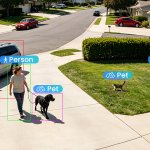
Once movement is detected, an AI-based detection system can analyze the visual information and classify the moving subject.
Depending on the camera and its capabilities, it may recognize categories such as:
– Person
– Vehicle
– Pet
– General movement
This creates an important difference between basic motion detection and AI detection.
Motion detection identifies a change in the scene, while AI detection attempts to determine what is causing that change.
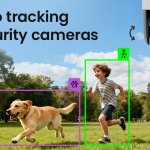
Some current smart cameras combine person, pet, and vehicle detection with AI tracking, allowing the system to identify a subject and then follow it as it moves.
Step 3: The Camera Starts Tracking
If the camera supports automatic tracking and has a movable lens, the system can begin following the detected subject.
This is where PTZ technology becomes important.
PTZ stands for:
– Pan – move horizontally from side to side
-Tilt – move vertically up and down
– Zoom – move closer to a subject digitally or optically, depending on the camera
When a person moves across a monitored area, the camera can adjust its position to keep the subject within the viewing area.
Step 4: The Camera Continues Following the Movement
AI tracking does not necessarily stop after the initial detection.
As the subject moves, the camera can continue adjusting its position to maintain the subject within the frame, depending on its tracking capabilities and the environment.
A simplified way to understand the process is:
Detect → Identify → Track → Follow
This combination allows a compatible camera to monitor movement across a wider area than a camera that remains fixed in one direction.
AI Tracking vs. Motion Detection: What’s the Difference?
These terms are often used together, but they describe different functions.
1. Motion Detection
Motion detection focuses on changes in the camera’s view.
It essentially asks:
“Did something move?”
For example, motion detection could be triggered when:
– A person walks across the yard
– A vehicle enters the driveway
– A pet runs through the camera’s view
– Tree branches move in the wind
Basic motion detection does not necessarily understand what caused the movement.
2. AI Detection
AI detection goes one step further by analyzing the detected object.
It asks:
“What is moving?”
Depending on the camera, the system may distinguish between people, vehicles, pets, and general movement.
This can help reduce unnecessary alerts because the system can focus on specific types of activity rather than treating every movement in the same way.
3. AI Tracking
AI tracking adds another layer:
“Where is the detected subject going?”
Instead of simply detecting or identifying the subject, a compatible PTZ camera can adjust its viewing direction to follow the subject.
In simple terms:
– Motion Detection → Detect movement
– AI Detection → Identify the subject
– AI Tracking → Follow the subject
Keeping these three concepts separate makes it easier to understand what a security camera can actually do.
What Happens When a Security Camera Tracks a Person?
Imagine a person walking across your backyard.
At first, the camera sees movement in its monitoring area. The detection system analyzes the activity and determines that the moving object is a person.
If automatic tracking is enabled, the camera can then adjust its viewing direction as the person continues walking.
For example:
A person enters the backyard
↓
Movement is detected
↓
AI identifies a person
↓
Tracking begins
↓
The person moves across the yard
↓
The camera adjusts its view
↓
The person remains within the monitored frame
This process can be particularly useful when the monitored area is too large for one fixed viewing angle.
Instead of recording a person for only a few seconds before they leave the frame, a tracking-enabled camera may be able to follow their movement across a larger portion of the area.
Where Is AI Tracking Useful?
AI tracking can be useful in many residential environments, particularly where there is a lot of open space.
1. Front Yard
A tracking camera can help monitor people moving toward or across the front yard.
This can be useful when the area in front of your home is wider than the field of view of a fixed camera.
2. Driveway
Driveways are often long and open, making them a practical application for tracking.
A person or vehicle may enter from one side and move toward the house. A camera with AI tracking can potentially follow that movement instead of keeping its view fixed.
3. Backyard
Backyards can contain several areas that need monitoring, including:
– Patio
– Lawn
– Side paths
– Play areas
– Gates
A PTZ camera with tracking capabilities can provide more flexible coverage across these areas.
For larger outdoor areas, an outdoor security camera with smart detection and flexible viewing options can provide better coverage.
4. Large Open Areas
AI tracking is particularly useful when a single fixed camera cannot easily cover an entire space.
Some modern PTZ cameras offer wide horizontal coverage specifically to monitor larger areas and automatically follow detected subjects.
What Are the Benefits of AI Tracking?
1. Wider Monitoring Coverage
A fixed camera continuously looks in one direction. A PTZ camera can change its viewing angle.
When combined with AI tracking, this can help monitor movement across a broader area.
2. Better Awareness of Moving Subjects
Instead of relying only on a fixed frame, tracking allows the camera to continue paying attention to a detected subject as it moves.
This can make it easier to understand what happened during an event.
3. Fewer Missed Moments
A person can quickly move out of the frame of a fixed camera.
Tracking can help reduce this limitation by adjusting the camera’s position when compatible tracking is activated.
4. More Flexible Outdoor Monitoring
For homes with large yards, driveways, or open outdoor spaces, the ability to change the camera’s viewing direction can provide greater flexibility than a fixed-angle camera.
What Are the Limitations of AI Tracking?
AI tracking can be useful, but it is not a guarantee that every moving subject will always be tracked perfectly.
1. Tracking Depends on Camera Movement
A camera needs the appropriate hardware to physically change its viewing direction.
A fixed security camera may provide AI detection, but it cannot physically follow a subject in the same way as a pan-and-tilt camera.
2. Obstructions Can Affect Tracking
Objects such as:
– Trees
– Vehicles
– Walls
– Fences
– Other people
can temporarily block the camera’s view.
When a subject disappears behind an obstruction, tracking performance may be affected.
3. Multiple Moving Subjects Can Be Challenging
If several people or objects move through the same area at the same time, the camera may need to determine which subject to prioritize.
The exact behavior depends on the camera’s detection and tracking system.
4. Lighting and Environment Matter
Outdoor conditions can also influence detection and tracking.
Low light, glare, rain, snow, or rapidly changing environmental conditions may affect how easily a camera identifies and follows a subject.
For this reason, AI tracking should be viewed as a smart monitoring tool rather than a replacement for thoughtful camera placement.
How to Choose a Security Camera With AI Tracking
If AI tracking is an important feature for your home, look beyond the phrase “AI-powered” and check what the camera actually supports.
1. AI Person Detection
If your primary concern is people approaching your property, look for a camera that can specifically identify people rather than simply detecting general motion.
2. PTZ Capability
For automatic physical tracking, check whether the camera supports:
– Pan
– Tilt
– Zoom
The wider the movement range, the more flexibility the camera may have when monitoring a large area.
3. Tracking Settings
Some cameras allow users to adjust detection or tracking behavior.
Depending on the model, settings may include detection areas, sensitivity, or other tracking-related controls.
4. Night Vision
Security concerns do not disappear after sunset.
If the camera will be used outdoors, consider how well it performs in low-light conditions. Night vision can be particularly important when tracking movement after dark.
5. Mobile Access
A security camera becomes more useful when you can check what is happening remotely.
Mobile access can allow you to:
– View live video
– Receive alerts
– Review recorded footage
– Check detected activity
FAQs
1. Does AI tracking follow people automatically?
It can, but this depends on the camera’s hardware and software. Automatic tracking generally requires a camera capable of changing its viewing direction, such as a PTZ model.
2. Does AI tracking work at night?
AI tracking can work at night on cameras designed for low-light monitoring, but performance depends on the camera’s night vision technology, lighting conditions, and detection capabilities.
3. Can AI tracking follow multiple people?
Some systems can detect multiple subjects, but tracking behavior varies between cameras. When several people move simultaneously, the camera may prioritize one subject according to its tracking logic.
4. Does AI tracking require a PTZ camera?
If you want the camera to physically move and follow a subject, PTZ capability is generally necessary. A fixed camera can still use AI to detect or identify objects, but it cannot physically change its viewing angle to follow them.
Conclusion
AI tracking is more than simply making a security camera move.
It combines several technologies to help a camera understand and respond to movement:
Motion Detection identifies that something has changed.
AI Detection helps determine what is moving.
AI Tracking allows a compatible camera to follow that subject as it moves.
For homeowners, this technology can be particularly useful in larger outdoor areas such as driveways, backyards, and open spaces. However, camera placement, lighting, obstructions, and the camera’s hardware all influence tracking performance.
Understanding how these technologies work can help you choose a security camera that matches the size of your property, the areas you want to monitor, and the type of activity you want to keep an eye on.